NEW YORK/LONDON, March 6 (Reuters) – Stocks sank on Friday as the U.S.-Israeli war against Iran drove oil prices sharply higher, while an unexpected loss of U.S. jobs in February increased hopes for Federal Reserve rate cuts but did little to cheer investors worried about economic weakness.
Trading was choppy in currencies and U.S. Treasuries as investors digested the Labor Department’s Bureau of Labor Statistics report showing that nonfarm payrolls fell by 92,000 jobs last month, versus economists’ forecasts for growth of 59,000.
February’s losses contrasted with a 126,000 downwardly revised increase in January. The unemployment rate rose to 4.4%, from January’s 4.3%.
“We’ve seen negative momentum in stocks in recent days on the geopolitical environment and concerns about a resurgence in inflation and rising oil prices,” said Jim Baird, chief investment officer with Plante Moran Financial Advisors.
“Today you layer on the news of an unexpectedly soft labor market report for February. Investors are recalibrating their expectations, not only for stocks but what it will mean for the Fed.”
On Wall Street at 10:51 a.m. (1551 GMT), the Dow Jones Industrial Average fell 623.30 points, or 1.30%, to 47,331.44, the S&P 500 fell 88.56 points, or 1.30%, to 6,742.15 and the Nasdaq Composite fell 264.65 points, or 1.17%, to 22,482.20.
MSCI’s gauge of stocks across the globe fell 11.01 points, or 1.07%, to 1,017.12, while the pan-European STOXX 600 index was down 1.31%.
Israel pounded the Lebanese capital Beirut on Friday after ordering an unprecedented evacuation of the entire southern suburbs of the city, in a major expansion of the Middle East war. U.S. President Donald Trump demanded Iran’s “unconditional surrender”, a dramatic escalation of his demands a week into the war he launched alongside Israel.
A sign outside the New York Stock Exchange marks the intersection of Wall and Broad Streets, Monday, Jan. 27, 2025, in New York. (AP Photo/Julia Demaree Nikhinson) via Associated Press
Qatar’s energy minister told the Financial Times in an interview published on Friday that the country expects all Gulf energy producers to shut down exports within weeks, pushing oil prices up to $150 a barrel.
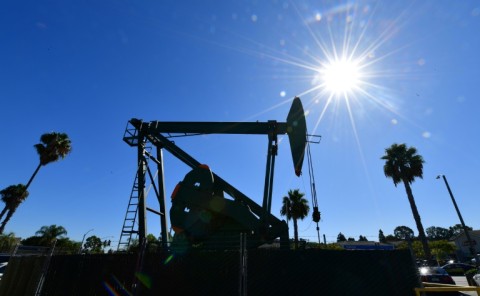
With that, crude oil rallied sharply and was set for its strongest weekly gain since the extreme volatility of the COVID-19 pandemic in spring 2020, as the war halted shipping and energy exports via the crucial Strait of Hormuz.
U.S. crude was up 9.86% to $88.97 a barrel after hitting its highest levels since October 2023, while Brent rose to $91.14 per barrel, up 6.71%, on the day after touching its highest price since April 2024.
In currencies, the dollar pared earlier gains against major currencies after the weak jobs report raised the possibility that the Fed could cut interest rates sooner than expected.
Traders are betting that the Fed’s first rate cuts will be in July but the probability they stay unchanged in June fell to 47.2% from 66.7% on Thursday, according to CBOE’s FedWatch tool.
“The Fed finds themselves in a tricky spot. Inflation is still elevated and now with oil prices surging, it’s going to create even more upward pressure there. At the same time you’re seeing the economy lose some momentum. There’s obviously pervasive uncertainty on a number of fronts both policy and geopolitically related,” said Baird.
The dollar index, which measures the greenback against a basket of currencies including the yen and the euro, rose 0.13% to 99.18, with the euro down 0.3% at $1.1572.
Against the Japanese yen, the dollar strengthened 0.01% to 157.59.
In cryptocurrencies, bitcoin fell 3.80% to $68,441.79. Ethereum declined 5.28% to $1,970.66.
In government bonds, the yield on benchmark U.S. 10-year notes fell 0.8 basis points to 4.138%, from 4.146% late on Thursday while the 30-year bond yield rose 2.2 basis points to 4.7745%.
The 2-year note yield, which typically moves in step with interest rate expectations for the Federal Reserve, fell 5.7 basis points to 3.542%, from 3.599% late on Thursday.
Gold edged up on Friday after softer U.S. payrolls data kept hopes for rate cuts alive, though a stronger dollar capped gains and left the precious metal on track for its first weekly decline in five weeks.
Spot gold rose 1.28% to $5,141.60 an ounce. U.S. gold futures rose 0.75% to $5,103.40 an ounce.
(Reporting by Sinéad Carew, Harry Robertson; Editing by Kate Mayberry, Alex Richardson, Jan Harvey and Nia Williams)
https://www.huffpost.com/entry/stocks-slide-gulf-oil-supply-fears-rattle-markets_n_69aae2ade4b03ae2f8861a9d