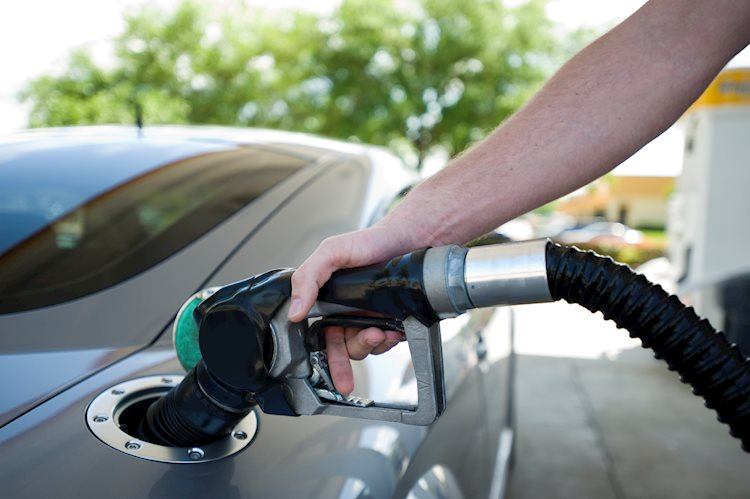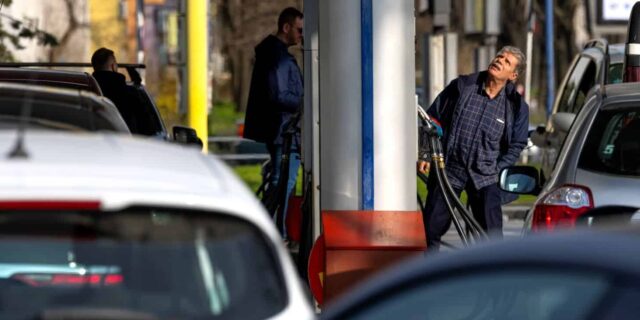
Motorists queue at a petrol station in Skopje, North Macedonia, 9 March 2026. Photo: EPA/GEORGI LICOVSKI.
Balkan governments have started taking measures to curb a spike in oil prices, which has escalated since Iran closed the Strait of Hormuz in response to US and Israeli attacks, threatening economies worldwide. The waterway between the Persian Gulf and Gulf of Oman is important for the oil trade as than 20 per cent of it passes through the Strait.
On Monday, Croatia announced a 450-million-euro package of measures to protect households and the economy from rising prices. It includes the continuation of fuel price regulation and freezing electricity and gas prices. “We have decided to intervene and reduce part of the excise duty and part of the fuel distributors’ margin,” Prime Minister Andrej Plenkovic said.
From Tuesday, for two weeks, the price of Eurodiesel will rise from the current 1.55 euros to 1.73 euros per litre. Without government measures, it would have reached 1.86 euros.
On Sunday, North Macedonia slashed VAT on petrol and diesel fuels from 18 to 10 per cent, to prevent further price hikes, at least for the near future. Since the start of the Middle East crisis, the price of petrol rose by some 12 per cent and of diesel by some 30 per cent.
“Lowering the tax is the quickest way to alleviate the impact of the price shocks and to prevent their spilling over to prices of food, transportation and services,” Prime Minister Hristijan Mickoski told the media.
Romania‘s government on Tuesday is to declare a 180-day state of crisis for the national oil sector, aiming to address risks to prices generated by the Middle East conflict. Among other measures, commercial markups on gasoline, diesel and the raw materials used to produce them will be capped, and fuel exports will be restricted.
Since February 28, fuel prices in Romania have risen by about 17 per cent for petrol and by around 20 per cent for diesel, marking one of the sharpest short-term increases in years.
In Bosnia and Herzegovina, authorities have moved to contain the impact of rising fuel prices with a combination of proposed tax relief and tighter market controls, though the measures remain limited.
In the Federation entity, officials have floated cutting or temporarily abolishing fuel excise duties to ease pressure on households and businesses, signalling a willingness to forgo budget revenues to curb inflation. In Republika Srpska, the response has focused more narrowly on enforcement.
In Turkey, where oil prices have risen by 6.9 per cent since the war started, the government has used special funds to partially offset the increases. However, the special fund is set to expire on March 24, and prices are expected to rise by as much as 20 per cent. The opposition and citizens are calling on the government to lift or reduce taxes on fuel.
Montenegro on Friday said it had introduced “maximum measures” to curb fuel prices by cutting excise duties.
Admir Sahmanovic, the Energy and Mining Minister, said that excise duties on Eurodiesel would be reduced by 50 per cent, while those on Eurosuper 98 and 95 would be cut by 25 per cent – measures that on Monday left the prices of diesel at 1.57 euros per litre, while Eurosuper 98 would be priced one cent lower and Eurosuper 95 at 1.52 euros per litre.
Serbia‘s government has introduced a series of measures since early March to control the rise in fuel prices, such as banning fuel exports, releasing fuel from state reserves and reducing excise duties on fuel.
On March 9, the government banned the export of crude oil, euro diesel, gasoline and aviation fuel. The export ban is valid until April 2. Five days later, the government decided to cut state levies on fuel prices by 20 per cent.
On Friday, President Aleksandar Vucic said excise duties would be reduced further. “Today, we will reduce them by another 40 per cent. Cumulatively, we will lower excise duties by about 61 per cent. We will almost give up state revenues to keep these prices stable,” he said.
Albania‘s Prime Minister, Edi Rama, declared on March 21 that the government would take measures on high oil prices.
“The price of oil has not only increased but is expected to increase further. For this reason, we have put the Transparency Board into motion… and we have also decided that every day that the price jumps above the ceiling of 220 ALL (2.29 euros), there will be an immediate 20-per-cent reduction in the oil excise tax,” Rama said, referring to a mechanism used in March 2022 for the first time after several protests against high oil prices.
In Bulgaria, Interim Prime Minister Andrei Gyurov stated on March 12 that the government is preparing measures worth 30 million euros to support households and businesses due to the increase in fuel prices. “We could take a populist approach and impose a cap on fuel prices, but that would drive fuel off the market. Our task is different, not to offer populism, but practical solutions,” he said.
The National Revenue Agency said it will strengthen control over gas stations to deal with speculative pricing while parliament voted on March 13 to give powers to the government to take measures against the price shock from high oil and natural gas prices.
In Kosovo, the Minister of Trade and Industry, Mimoza Kusari, on March 4 said she had signed an instruction on the prices of oil products which sets the maximum allowed trade margin for wholesale sales up to 2 eurocents per liter and for retail sales, up to 12 eurocents per liter.
“The decision comes after continuous monitoring of the oil market, analysis of daily records by Kosovo Customs and reports from the Central Inspectorate for Market Surveillance, which found that price increases from imports were immediately reflected in sales prices,” Kusari-Lila said.
https://balkaninsight.com/2026/03/23/middle-east-crisis-balkan-countries-act-to-ease-spike-in-oil-prices/bi/