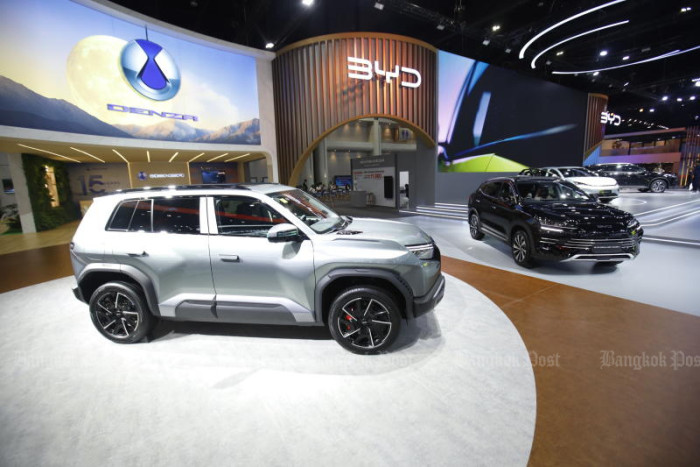
BYD electric vehicles, one of the Chinese car manufacturers, are displayed at the annual Bangkok International Motor Show at Impact Muang Thong Thani. The event runs from Tuesday to April 5. (Photo: Pattarapong Chatpattarasil)
Surging oil prices driven by the US-Israel war on Iran could accelerate the global adoption of electric vehicles – a sector that helped China overtake Japan to become the world’s largest seller of automobiles last year.
“The closure of the Strait of Hormuz could be a game-changer for EVs,” said David Brown, director of energy transition research at Wood Mackenzie, in a report released on Friday.
The “eye-watering” 50% surge in global oil prices so far this month would further incentivise consumers to pivot towards EVs, he said.
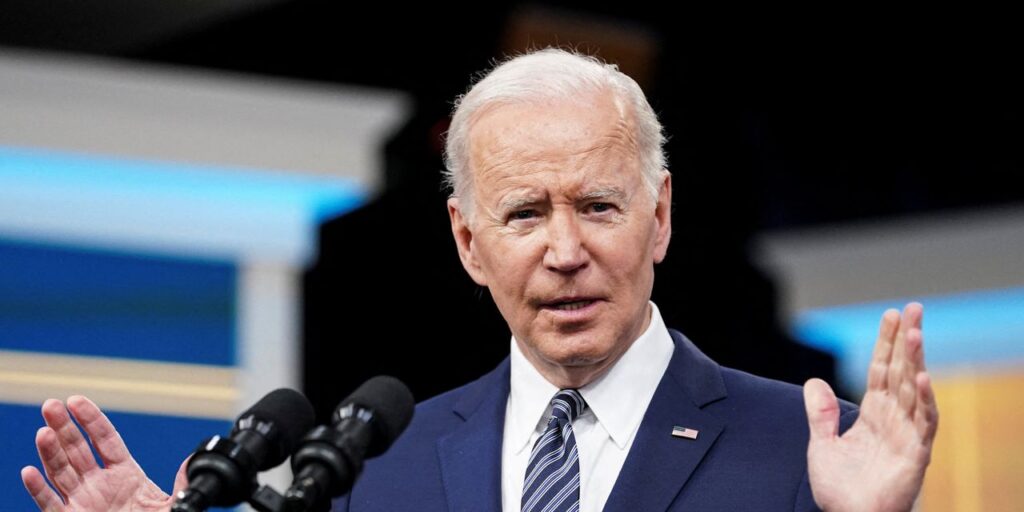
Brent crude was trading at more than US$100 per barrel on Monday, as the upwards pressure on oil prices continued. On Saturday, US President Donald Trump threatened to “obliterate” Iran’s power plants unless it fully reopened the Strait of Hormuz to shipping traffic within 48 hours.
“In those countries with access to low-cost Chinese EVs, the competitive advantage over gasoline-engined cars will come even sooner,” Brown said, noting that Brazil had already become the largest overseas market for Chinese EV giant BYD.
Justin Feng, an Asia economist at HSBC, also highlighted this trend in a Friday report.
He said higher and more volatile oil prices could turn EVs into a clearer “cost-savings proposition” if the conflict persisted, accelerating the electrification of Asia’s road transport.
There are now 39 countries where EVs account for more than 10% of total auto sales, up from four in 2019, according to a report by the British think tank Ember released on Wednesday. Emerging markets are adopting electric cars at a rapid pace, with some now surpassing advanced economies in terms of their EV sales share, the report added.
The rising global appetite for EVs – which is being further stimulated by the Middle East conflict – could offer a major boost to China’s automotive industry, which eclipsed Japan in global sales for the first time last year.
Chinese carmakers led the world in global new vehicle sales in 2025, ending Japan’s more than two-decade reign in the number one position, Nikkei reported on Saturday, quoting data from carmakers and data company MarkLines.
Chinese car giants BYD and Geely also surpassed their Japanese competitors Nissan and Honda in terms of sales, the report said.
Of the world’s top 20 carmakers by sales last year, six were Chinese and five were Japanese, according to Nikkei.
China exported 8.32 million vehicles last year, a 30% year-on-year increase, according to data from the China Automobile Dealers Association. Total EV exports reached 2.32 million, up 38% year on year.
Europe remains the largest export market for China’s EVs, followed by Southeast Asia, Latin America and the Middle East, data showed.
However, if the conflict in the Middle East continues, the fossil-fuel shock could be a near-term headwind for EV manufacturing, which remains energy- and carbon-intensive, HSBC’s Feng warned.
Thailand, an emerging EV manufacturing hub in Asia, appears particularly vulnerable to energy supply shocks. According to Feng, nearly 60% of Thailand’s oil imports and almost one-third of its natural gas imports come from the Gulf.
In contrast, China’s EV production is expected to be more resilient due to the country’s more robust supply chains and greater energy flexibility.
https://www.bangkokpost.com/business/general/3223355/why-the-iran-war-could-be-a-gamechanger-for-evs-and-chinas-car-industry