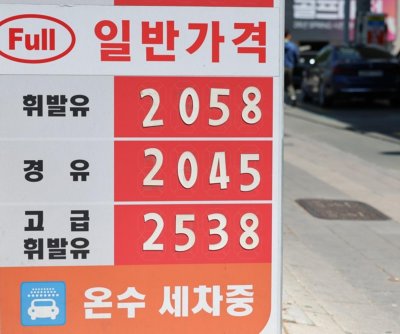
Gasoline and diesel fuel prices are displayed at a gas
station in Seoul, South Korea, April 26, 2026. The average gasoline price in
the country came to 2,000.1 won ($1.33) per liter, or about $5.03 per gallon,
as of April 24, according to data from Korea National Oil Corp. Photo by YONHAP
/ EPA
April 29 (Asia Today) — This commentary is the Asia Today Editor’s Op-Ed.
South Korea’s oil price cap policy is increasingly showing signs of strain, as a dispute between the government and refiners over compensation standards raises broader concerns about market distortion and policy sustainability.
At the center of the conflict is how to calculate losses. Refiners say the current system creates a structural “reverse margin,” where selling more fuel leads to greater losses. Based on Singapore benchmark prices, the industry estimates it lost about 1.27 trillion won ($857 million) in just the final two weeks of March. During that period, international gasoline prices reached 1,373 won ($3.65 a gallon), while the domestic pre-tax supply price was set at 871 won ($2.31 a gallon), leaving refiners to absorb losses of more than 500 won per liter.
The government, however, maintains that compensation should be based on actual crude import prices and production costs. Under this method, the scale of compensation would drop sharply to around 100 billion won ($68 million), far below industry expectations.
This gap reflects a deeper structural issue. Refining is a process in which multiple petroleum products are produced simultaneously from a single input, crude oil. Attempting to isolate costs for individual products is not only technically difficult but could also force companies to disclose sensitive operational data. Past attempts to establish such cost calculations have failed, underscoring the complexity of the issue.
Legal risks are also emerging. Companies with significant foreign ownership could face pressure from overseas shareholders if prolonged losses are seen as undermining shareholder value. In extreme cases, this could lead to investor-state disputes, raising the possibility of reputational and diplomatic consequences for South Korea.
There are also concerns about supply stability. If refiners shift toward exports, where margins are more favorable, or scale back domestic supply, the market could face a paradox in which regulated prices remain low but fuel availability declines.
Meanwhile, the fiscal burden is mounting. The government’s 4.2 trillion won ($2.84 billion) budget for the program is expected to be depleted in the first half of the year. Artificially suppressing prices may also dampen incentives to reduce consumption, as suggested by recent increases in fuel demand.
These developments point to the limits of administrative price controls in a complex global market. A more sustainable approach would involve aligning compensation with international price signals and considering market-based tools such as fuel tax adjustments.
Without such adjustments, the policy risks undermining both the financial health of refiners and the stability of the broader energy supply chain.
— Reported by Asia Today; translated by UPI
© Asia Today. Unauthorized reproduction or redistribution prohibited.
Original Korean report: https://www.asiatoday.co.kr/kn/view.php?key=20260429010009507
https://www.upi.com/Voices/2026/04/29/perspective-oil-price-cap-policy/7521777518698/