Damian Troise and Alex Veiga
Updated September 2, 2026 — 10:43am, first published September 2, 2026 — 5:18am
The Australian sharemarket has opened sharply lower after Wall Street fell as another round of US military strikes on Iran sent oil prices higher, stoking worries about stubbornly high inflation. A bond market sell-off deepened, putting more pressure on stocks.
The S&P/ASX 200 was down 103.1 points, or 1.1 per cent, in early trade, with nine of 11 industry sectors lower. The ASX lost 0.1 per cent on Tuesday. The Australian dollar was weaker at US71.44¢ at 10.25am AEST.
Wall Street went backwards on Tuesday (US time), with technology stocks weighing down indexes. AP Mining stocks were hit hard in early trade. BHP lost 2.6 per cent, Fortescue fell 1.1 per cent and Rio Tinto slumped 1.5 per cent while gold miners tumbled as the precious metal held its decline as attacks in the Middle East and a global bond sell-off ratcheted up bets that the Federal Reserve may need to raise interest rates to rein in inflation.
Bullion was trading around $US4330 an ounce, after falling almost 6 per cent over the previous three sessions to a two-week low. Northern Star tumbled 4.4 per cent and Evolution Mining fell 4.1 per cent.
Financial stocks are lower with Commonwealth Bank falling 0.6 per cent, National Australia Bank down 1.1 per cent, Westpac sliding 0.7 per cent and ANZ Bank 1 per cent lower in early trade.
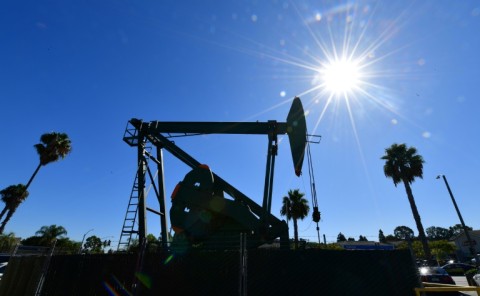
Energy stocks advanced after oil prices rose again on escalating tensions in the Middle East. Crude advanced for a third session on heightened concerns about prolonged disruptions to energy flows through the Strait of Hormuz after an escalation of hostilities between the US and Iran. Brent rose above $US95 a barrel after surging 4.6 per cent overnight, while West Texas Intermediate traded near $US91. Woodside Energy rose 2.4 per cent and Santos added 1.5 per cent.
Telstra shares are 1.8 per cent higher after releasing the results of an external investigation into the July 8 outage that crippled its network.
Technology stocks followed their Wall Street peers lower with WiseTech losing 3.9 per cent, Xero down 1.4 per cent, while Technology One and NEXTDC were both 2.4 per cent weaker.
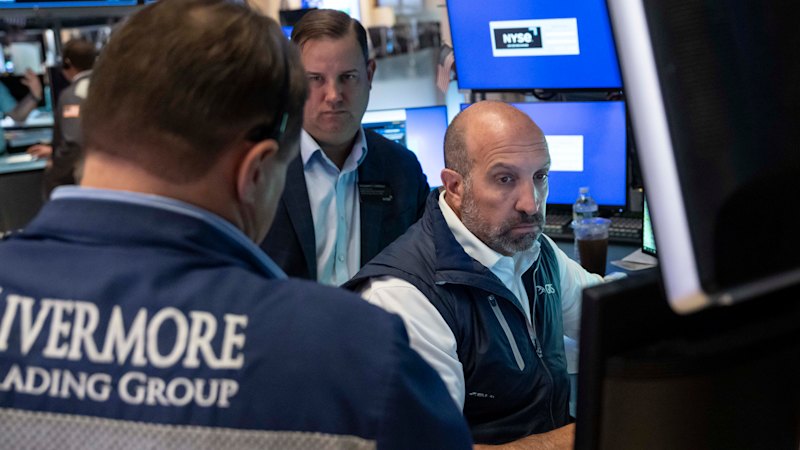
Overnight, the S&P 500 index fell 0.7 per cent. The Dow Jones Industrial Average dropped 0.8 per cent, and the Nasdaq composite slid 1 per cent. The major indexes have lost ground three days in a row.
The weak start to September follows a shaky but mostly positive month for Wall Street. Every major index notched monthly gains in August. The same worries continue to hang over Wall Street, though, including anxiety over rising prices, government debt, and the impact of global conflicts on the US and the global economy.
Technology stocks were among the heaviest weights on the market. Nvidia fell 1.5 per cent, Amazon dropped 1.9 per cent and Advanced Micro Devices gave up 2.4 per cent. Their big market values tend to give them more influence over the broader market’s direction and their growth amid the artificial-intelligence boom has been heavily reliant on borrowing, which becomes more expensive as interest rates rise.
Much of the continued pressure being felt by Wall Street is coming from an ongoing sell-off in US government bonds. The yield on the 10-year Treasury, which tends to impact mortgage rates, rose to 4.79 per cent from 4.75 per cent late Monday. It was as low as 4.20 per cent at the beginning of 2026.
The yield on the 2-year Treasury, which closely tracks expectations for Federal Reserve moves on interest rates, rose to 4.39 per cent from 4.34 per cent late Monday. That’s up significantly from about 3.50 per cent at the beginning of 2026.
Bond yields, which have an inverse relationship to prices, rise as bond prices fall. Rising yields signal that investors are demanding a higher return from Treasurys because they are becoming riskier. Growing government debt is highlighting that risk.
The US debt surpassed $US40 trillion ($56 trillion) two weeks ago, a shocking milestone as defence costs and interest on the burgeoning deficit make up an enormous share of federal spending. The bond sell-off is global, with other nations facing the same economic pressures.
Higher yields on bonds signal higher borrowing costs on mortgages and a wide range of other loans. Higher borrowing costs tend to weigh down investments, including stocks, while making it more difficult for businesses to expand.
Higher oil prices have pushed up costs for everything from gasoline to shipped goods, fuelling inflation that has been squeezing households and businesses.
Higher inflation has also been a problem for the Federal Reserve. The rate of inflation is well above 3 per cent, and Wall Street expects the Fed to raise interest rates before the year is over in order to try to bring inflation down to its 2 per cent target. Investors are betting on a 66 per cent chance that the central bank will raise its benchmark interest rate at its upcoming September meeting, according to CME FedWatch.
The Fed will get more updates on inflation ahead of the meeting. Meanwhile, it is getting updates on the jobs market this week. On Tuesday, the government reported that US job openings rose slightly in July. A broader monthly report for August will be released on Friday.
All told, the S&P 500 fell 54.67 points to 7631.47. The Dow dropped 419.02 points to 52,766.88, and the Nasdaq fell 271.11 points to close at 26,099.77.
Markets in Europe fell and markets in Asia ended mixed.
With AP, Bloomberg
The Market Recap newsletter is a wrap of the day’s trading. Get it each weekday afternoon .
From our partners
https://www.smh.com.au/business/markets/asx-set-to-slump-as-wall-street-falls-on-higher-oil-prices-yields-20260902-p60tkw.html?ref=rss&utm_medium=rss&utm_source=rss_feed