LIVE | Tehran moots plans to charge for passage through waterway
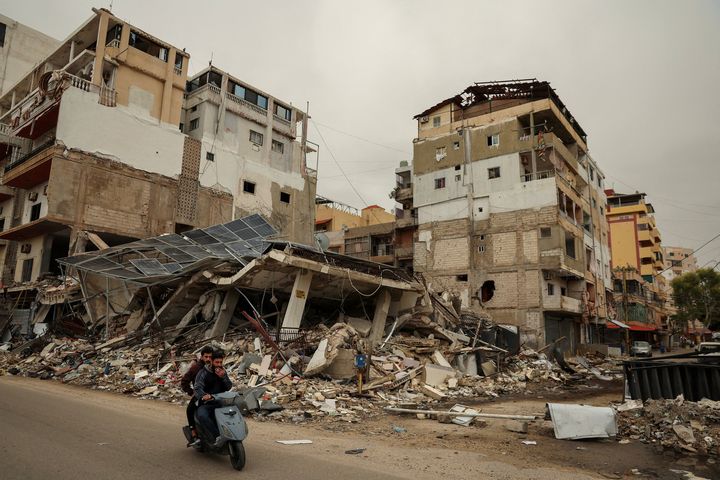
Men ride a scooter past the rubble of a building destroyed by an Israeli strike as the US-Israeli conflict with Iran continues, in Tyre, Lebanon. Photo: Reuters
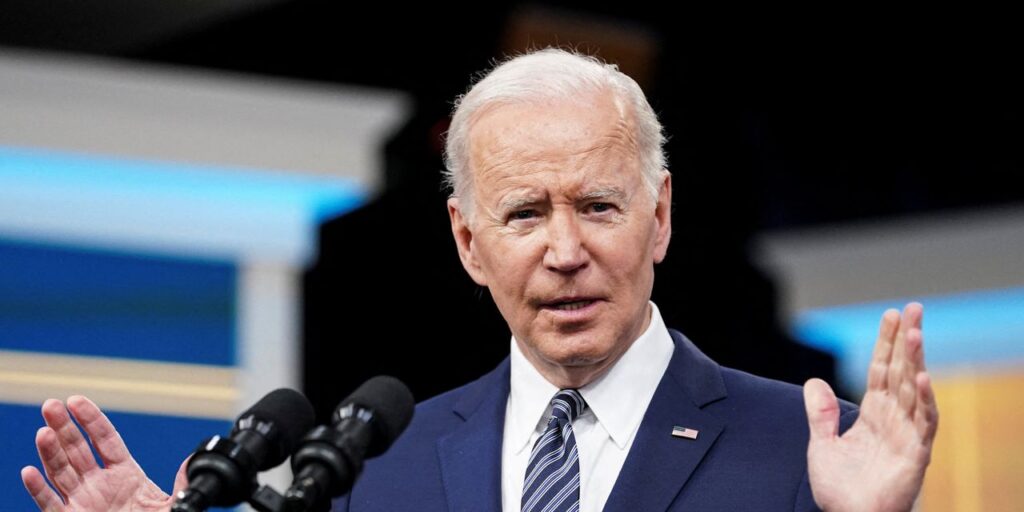
US president Donald Trump warned the war could escalate. Photo: AP
Steve Holland and Enas Alashray
Reuters
Today at 06:30
Follow our live blog on the war in the Middle East here:
Key updates
Donald Trump fires Pam Bondi as US attorney general
Macron says Trump’s comments mocking him and his wife Brigitte were ‘neither elegant, nor commensurate’ with the moment
Peacekeepers at ‘unacceptable risk’, says Helen McEntee
‘Everything you buy…you are going to see higher prices’ – hauliers declare fuel costs now a ‘national emergency’ as IRHA seeks urgent Government action
Taoiseach Micheál Martin says Government not looking at fuel rationing ‘at this stage’
Iran’s military warns of ‘more destructive’ attacks until adversaries’ ‘surrender’
Irish tourists could face surcharges and cancellations as price of jet fuel climbs
US vows to target more Iranian infrastructure as nations seek to open Hormuz President Donald Trump said the U.S. “hasn’t even started destroying what’s left in Iran”, reiterating vows to increase the ferocity of attacks on its infrastructure, as dozens of countries sought ways to restart vital energy shipments through the Strait of Hormuz.
Nearly five weeks after it started with a joint U.S.-Israeli aerial assault, the war in Iran continues to spread chaos across the region and roil financial markets, raising the pressure on Trump to find a quick resolution to the conflict.
Trump has stepped up his rhetoric in recent days as negotiations conducted via intermediaries with new leaders in Iran show limited signs of progress.
The U.S. military “hasn’t even started destroying what’s left in Iran. Bridges next, then Electric Power Plants,” Trump wrote on social media late on Thursday, adding that Iran’s leadership “knows what has to be done, and has to be done, FAST!”
He earlier posted video of the U.S. bombing a newly constructed bridge between Tehran and the major northwest suburb of Karaj. The B1 bridge was scheduled to open to traffic this year. According to Iran’s state media, eight people were killed and 95 others were wounded in the U.S. attack.
“Striking civilian structures, including unfinished bridges, will not compel Iranians to surrender,” Iran Foreign Minister Abbas Araqchi said in a statement.
Satellite images also showed smoke rising from the port in Qeshm, an Iranian island strategically located in the Strait of Hormuz, earlier this week.
CONCERNS ABOUT POTENTIAL U.S. WAR CRIMES RAISED
Over 100 American international law experts said on Thursday the conduct of U.S. forces and statements by senior U.S. officials “raise serious concerns about violations of international human rights law and international humanitarian law, including potential war crimes.”
A letter signed by the experts particularly noted a mid-March comment from Trump where he said the U.S. may conduct strikes on Iran “just for fun.” It also cited comments from Pentagon chief Pete Hegseth from early March in which he said the U.S. does not fight with “stupid rules of engagement.”
In a speech on Wednesday night, Trump repeated his threats against Iran’s civilian power plants and gave no clear timeline for ending hostilities. That drew vows of retaliation from Iran, weighed on global share prices and sent oil prices surging on concerns the Strait of Hormuz would remain largely closed.
Britain chaired a virtual meeting on Thursday of some 40 countries to explore ways to restore freedom of navigation that did not produce any specific agreement, although participants agreed that all nations should be able to use the waterway freely, one official said.
UNSC TO VOTE ON BAHRAINI PLAN TO PROTECT SHIPPING
The U.N. Security Council is set to vote on Saturday on a Bahraini resolution to protect commercial shipping in and around the strait, diplomats said, but veto-wielding China made clear its opposition to authorizing any use of force.
Any military action would be “legitimising the unlawful and indiscriminate use of force, which would inevitably lead to further escalation of the situation and lead to serious consequences,” China’s U.N. envoy Fu Cong told the Security Council on Thursday.
Iran has effectively shut down the strait, which normally carries about a fifth of the world’s total oil trade, in retaliation for U.S.-Israeli attacks that began on February 28.
Tehran offered a competing vision for future control of the strait, and said it was drafting a protocol with neighboring Oman that would require ships to obtain permits and licences.
The European Union’s foreign policy chief Kaja Kallas pushed back against Tehran’s plan, saying Iran cannot be allowed to charge countries a bounty to let ships pass. “International law doesn’t recognise pay-to-pass schemes,” wrote Kallas on social media.
FEARS OF IRANIAN STRANGLEHOLD ON MIDEAST ENERGY
There are fears the conflict may leave Iran with a stranglehold over Middle East energy supplies now that it has shown that it can block the Strait of Hormuz by targeting oil tankers and attacking Gulf countries hosting U.S. troops.
Gulf states say they reserve the right to self-defence but have refrained from responding militarily to repeated Iranian attacks over the past month, seeking to avoid escalation into a far more devastating all-out Middle East war.
Kuwait reported that its air defences were working to intercept missiles and drones twice on Friday.
Thousands of people have been killed and tens of thousands injured across the Middle East since the war began, with the head of the International Federation of Red Cross and Red Crescent Societies delegation saying on Thursday that medical needs were rising exponentially and supplies could run low.
Fuel shortages have already caused economic strains across Asia and are expected to bite in Europe soon, while a report by two U.N. agencies warned a sharp economic slowdown could spark a cost-of-living crisis in Africa.
Reuters
UN to vote on Hormuz resolution as China opposes authorization of force Draft resolution seeks authorisation to protect Hormuz shipping China says authorising force would bring further escalation Resolution authorises “all defensive means necessary” Trump vows continued attacks, raising doubts over US role in Strait security The UN Security Council is to vote on a Bahraini resolution to protect commercial shipping in and around the Strait of Hormuz, diplomats said on Friday, but veto-wielding China made clear its opposition to authorising any use of force.
Two diplomats said the meeting of the Council’s 15 members and the vote were set for Saturday morning, rather than Friday as earlier planned. Friday is a UN holiday.
Oil prices have surged since the United States and Israel struck Iran at the end of February, unleashing a conflict that has run for more than a month and effectively closed the key shipping artery.
Diplomats said Bahrain, the current chair of the Security Council, finalized a draft resolution seen by Reuters that would authorize “all defensive means necessary” to protect commercial shipping.
Earlier on Thursday, Bahrain’s Foreign Minister Abdullatif bin Rashid Al Zayani told the council that a vote would be held on Friday, “God willing”, adding that Bahrain looked forward to a “unified position from this esteemed council.”
Bahrain, backed in its efforts to secure a resolution by other Gulf Arab states and Washington, had previously dropped an explicit reference to binding enforcement in a bid to overcome objections from other nations, particularly Russia and China.
The draft seen by Reuters authorizes the measures “for a period of at least six months … and until such time as the council decides otherwise.”
However, in remarks to the Security Council on Thursday morning, China’s U.N. envoy Fu Cong opposed authorizing force.
Such a move would be “legitimizing the unlawful and indiscriminate use of force, which would inevitably lead to further escalation of the situation and lead to serious consequences,” he added.
A fourth draft of the resolution was put under a so-called silence procedure for approval until Thursday noon (1600 GMT), but a Western diplomatic source said the silence had been broken, by China, France and Russia.
Diplomats said a text had subsequently been finalised, or “put in blue,” which means a vote can take place.
A Security Council resolution requires at least nine votes in favor and no vetoes from the five permanent members, Britain, China, France, Russia and the United States.
Al Zayani said Iran’s “unlawful and unjustified attempt” to control international navigation in the Strait of Hormuz threatened global interests and required a “decisive response.”
The secretary-general of the 22-member League of Arab States, Ahmed Aboul Gheit, told the Security Council it backed Bahrain’s efforts to secure a resolution.
On Thursday Britain hosted a meeting with more than 40 countries on efforts to reopen and ensure safe passage through the Strait of Hormuz and also expressed support for Bahrain’s move to secure a resolution on the issue.
On Wednesday, U.S. President Donald Trump vowed to continue attacks, but did not lay out a plan to re-open the strait.
That drove oil prices even higher, by fuelling concern that the United States might not take a major role in ensuring safe passage for shippers through the waterway.
David Brunnstrom, Reuters
Drones hit Kuwait’s Mina al-Ahmadi refinery, fires reported, no injuries Kuwait Petroleum Corporation said its Mina al-Ahmadi refinery was hit by drones early on Friday, setting off fires at operating units, according to the state news agency, but no injuries were reported.
Trump mocks Starmer as weak as UK leads push to reopen Strait of Hormuz The US president impersonated the Prime Minister in his latest sideswipe at Britain.
Donald Trump has mocked Keir Starmer as weak and had a fresh dig at the UK’s navy as Britain led diplomatic efforts to try and reopen the critical Strait of Hormuz shipping lane, closed by the Iran war.
The US president impersonated the Prime Minister as he recounted Mr Starmer saying he had to ask his team about sending “two old broken-down aircraft carriers” to the Middle East.
Mr Trump said Britain “should be our best” ally, but had not been in his latest sideswipe over the UK’s refusal to be drawn into the conflict with Tehran, which has emerged in a video from a private Easter White House lunch.
It is not the first time the American leader has been critical of the UK’s aircraft carriers, having previously dismissed them as “toys” that “aren’t the best”.
Earlier this week, US defence secretary Pete Hegseth rounded on Britain for failing to send warships to the region, saying “last time I checked there was supposed to be a big, bad Royal Navy that could be prepared to do things like that as well”.
Their disparaging remarks come as the King, who is head of the armed forces, is due to travel to Washington later this month for a state visit to mark the 250th anniversary of American independence.
Speaking at the lunch on Wednesday, Mr Trump said: “I asked (the) UK, who should be our best. In fact the King is coming over here in two weeks, he’s a nice guy, King Charles. But should be our best but they weren’t our best [ally].
“I said ‘you have two, old broken-down aircraft carriers, do you think you could send them over’?”
Impersonating Starmer with a weak voice, Mr Trump added: “Ohhh I’ll have to ask my team.
“I said ‘you’re the Prime Minister, you don’t have to’.
“No, no, no, I have to ask my team. My team has to meet, we’re meeting next week.
“But the war already started. Next week the war’s going to be over… in three days.”
Latest: World anxious to open Hormuz Strait while Trump and Iran trade threats Dozens of countries sought ways to restart vital energy shipments through the Strait of Hormuz on Thursday after U.S. President Donald Trump vowed more aggressive strikes on Iran, sending oil prices higher again and deepening strain on consumers.
In a speech on Wednesday night, Trump said operations would be intensified and gave no timeline for ending hostilities, drawing threats of retaliation from Tehran and depressingshare prices.
“We’re going to hit them extremely hard over the next two to three weeks. We’re going to bring them back to the Stone Ages where they belong,” Trump said in the speech amid mounting domestic pressure to end the conflict.
Britain chaired a virtual meeting on Thursday of some 40 countries to explore ways to restore freedom of navigation that did not produce any specific agreement, although participants agreed that all nations should be able to use the waterway freely, one official said.
Trump persisted with his threats on Thursday, saying in a social media post: “IT IS TIME FOR IRAN TO MAKE A DEAL BEFORE IT IS TOO LATE”. He also posted footage of what appeared to be strikes on a bridge in Iran.
Iran has effectively shut down the Strait of Hormuz, which normally carries about a fifth of the world’s total oil consumption, in retaliation for U.S.-Israeli strikes that began on February 28. The war has caused a spike in oil prices, inflation concerns, supply-chain problems and worries about the impact on the global economy.
Still defiant despite the death of a slew of its leaders, Tehran offered a competing vision for future control of the strait, and said it was drafting a protocol with Oman that would require ships to obtain permits and licenses.
“These requirements will not mean restrictions, but rather to facilitate and ensure safe passage and provide better services to ships that pass through this route,” Deputy Foreign Minister Kazem Gharibabadi said, according to the official IRNA news agency.
An Iranian military spokesperson on Thursday said the strait would remain closed “long term” to the U.S. and Israel.
The European Union’s foreign policy chief Kaja Kallas pushed back against Tehran’s plan, saying Iran cannot be allowed to charge countries a bounty to let ships pass. “International law doesn’t recognise pay-to-pass schemes,” wrote Kallas on X.
Oil hits $108
Benchmark Brent crude prices LCOc1jumped by about 7% to around $108 per barrel, U.S. bond yields spiked and global equity markets gave back gains.
“The key question in all investors’ minds is ‘When is this going to be over?'” said Russel Chesler, head of investments and capital markets at VanEck Australia.
Trump warned that the war could escalate if Iran did not give in to Washington’s terms, with strikes on its energy and oil infrastructure possible. He told countries that rely on fuel shipments through the Strait of Hormuz to “just grab it”.
However, European and other states have said they will only help secure the strait if there is a ceasefire.
“It can only be done in consultation with Iran,” French President Emmanuel Macron said.
Iran threatens more attacks
Iran’s armed forces responded to Trump with a warning of “more crushing, broader and more destructive” attacks in store.
The war will continue until the “permanent regret and surrender” of Iran’s enemies, said Ebrahim Zolfaqari, spokesperson for the Iranian military’s Khatam al-Anbiya central headquarters, in a statement carried by Iranian media.
Iran’s Fars news agency later listed several bridges in Saudi Arabia, Kuwait, Abu Dhabi and Jordan as potential targets for Iranian military operations after one of its own bridges was hit by air strikes. The Revolutionary Guards said they had targeted an Amazon cloud computing centre in Bahrain.
There are fears the conflict may leave Iran with a stranglehold over Middle East energy supplies now that it has shown that it can block the Strait of Hormuz by targeting oil tankers and attacking Gulf countries hosting U.S. troops.
Gulf states say they reserve the right to self-defence but have refrained from responding militarily to repeated Iranian attacks over the past month, seeking to avoid escalation into a far more devastating all-out Middle East war.
Iran’s parliament was reviewing a bill that would formalise the blocking of vessels from hostile countries passing through the strait and the charging of tolls for others wishing to pass, spokesperson Abbas Goodarzi said.
Strike on iran bridge kills 8
Thousands of people have been killed and tens of thousands injured across the Middle East since the war began, with the head of the International Federation of Red Cross and Red Crescent Societies delegation saying on Thursday that medical needs were rising exponentially and supplies could run low.
Iran’s state media said eight people were killed and 95 wounded when a bridge linking Tehran and the western city of Karaj was hit by air strikes. Some large steel producers and Tehran’s Pasteur Institute of Iran medical research centre were separately reported to have sustained serious damage.
The Revolutionary Guards said they had targeted U.S.-linked steel and aluminium facilities in Gulf states and an Oracle data center in Dubai, and would step up such attacks if Iranian industries were hit again.
Sirens and the booms from interceptors rang out over Jerusalem after the Israeli military said it had identified the launch of a missile from Yemen toward Israel.
Yemen’s Iran-aligned Houthis first claimed an attack on Israel at the end of March, as the conflict with Iran has expanded across the region.
Fuel shortages have already caused economic strains across Asia and are expected to bite in Europe soon, while a report by two U.N. agencies warned a sharp economic slowdown could spark a cost-of-living crisis in Africa.
Donald Trump fires Pam Bondi as US attorney general
Macron says Trump’s comments mocking him and his wife Brigitte were ‘neither elegant, nor commensurate’ with the moment Emmanuel Macron has told Donald Trump that the war in Iran requires a “serious” approach in the most scathing attack on the US president by an ally since the war began.
Speaking to reporters in South Korea, the French leader said that the conflict was “not a show” and that Trump should not make contradictory remarks about his aims.
“When you want to be serious you don’t say every day the opposite of what you said the day before,” Macron said. “And maybe you shouldn’t be speaking every day. You should just let things quieten down.”
Trump has offered mixed messages on his objectives in the Iran war, often in the same day.
His comments came hours after Trump sparked outrage by mocking Macron and his wife, Brigitte, over a video that surfaced last year in which she appeared to shove the French president. “He is still recovering”, Trump told reporters in comments that sparked a significant backlash in France.
Reacting, the French leader said that Trump’s comments mocking him and his wife Brigitte were “neither elegant, nor commensurate” with the moment.
On Wednesday, Trump attacked France for not allowing US aircraft to fly over its space – a decision already implemented by Spain, Austria and Switzerland.
Speaking today, the French president said it would be unrealistic to launch a military operation to force open the Strait of Hormuz.
“Some people defend the idea of freeing the Strait of Hormuz by force via a military operation, a position sometimes expressed by the United States, although it has varied.
“This was never the option we have supported because it is unrealistic,” he said. “It would take forever, and would expose all those who go through the Strait to risks from the Revolutionary Guards but also ballistic missiles,” he said.
Asked about Trump’s criticism of NATO allies, Macron said:
“I don’t want to provide a running commentary of an operation the Americans have decided on their own with Israel. They can deplore the fact they’re not being helped, but that’s not our operation. We want peace as soon as possible.”
“This is not a show,” Macron added. “We’re talking about war and peace… Let’s be serious and not say one day the opposite of what we said the day before,” he added, without saying if he was talking about Trump.
On Trump’s threats to pull the US out of the NATO alliance, Macron said: “Alliances such as NATO derive their strength from what is not said, that is, from the trust that lies behind them. If you create doubt every day about your commitments, you hollow out its substance.”
Peacekeepers at ‘unacceptable risk’, says Helen McEntee Irish peacekeepers in Lebanon are at “unacceptable risk” says Helen McEntee as Defence Ministers with UNIFIL troops discuss the killing of three Indonesian personnel.
In the wake of the death of three Indonesian peacekeepers in Lebanon last weekend, the defence minister Helen McEntee attended a call convened by the French defence minister Catherine Vautrin along with ministers from other European troop contributing countries.
After the meeting, minister McEntee said “increased attacks on patrols and the broader escalation in hostilities are placing peacekeepers at unacceptable risk.”
“The recent killing of three Indonesian peacekeepers, alongside the injury of others in separate incidents, underlines the very real and growing dangers facing those serving with the United Nations in Lebanon.”
The defence minister said that attacks on United Nations Interim Force in Lebanon (Unifil) personnel are “a clear violation of international law.”
“Those who serve to maintain peace and stability must never be targeted, and there must be full accountability for those responsible.”
The minister said that she joined the discussion with fellow European defence ministers who also have peacekeepers in south Lebanon as security situation in the area worsens.
“I joined this discussion with European partners to address the deteriorating security situation, to strengthen coordination between troop contributing countries and to ensure that peacekeepers are properly protected and supported to carry out their mandate.”
Earlier this week Minister McEntee confirmed that all Irish personnel serving in Lebanon were “safe and fully accounted for” after three peacekeepers nearby were killed last weekend.
Today she said: “Ireland’s priority is the safety and security of our Defence Forces personnel and all peacekeepers.”
The minister said she was working with fellow European defence ministers on “contingency planning” to make sure the peacekeepers can operate “in an increasingly volatile environment.”
“Ireland remains steadfast in its commitment to peacekeeping and to supporting stability in Lebanon,” she said.
In March Israel launched a ground invasion of Lebanon while targeting the Iranian-backed militant group Hezbollah, as the US began the war with Iran.
Three UN peacekeepers from Indonesian were killed in two separate incidents in southern Lebanon over 48 hours last weekend.
Two of the Indonesian personnel were killed near Bani Hayyan, when “an explosion of unknown origin destroyed their vehicle” according to Unifil.
A third peacekeeper was severely injured, and a fourth was also hurt in the incident.
Camp Shamrock, where members of the Irish Defence Forces are based, is around 20km from the site of the explosion.
An earlier incident at Adchit Al Qusayr, about 25km from Camp Shamrock, saw another Indonesian peacekeeper killed when a projectile exploded in a Unifil position.
Another peacekeeper was “critically injured” in the incident, too.
UN secretary-general Antonio Guterres said attacks on peacekeepers are grave violations of international humanitarian law and may amount to war crimes.
Unifil is stationed in southern Lebanon to monitor hostilities along the demarcation line with Israel – an area that is at the heart of clashes between Israeli troops and Iran-backed Hezbollah fighters.
Lebanon was pulled into the war in the Middle East when Hezbollah fired rockets at Israel in solidarity with Tehran, two days after Iran was attacked by Israel and the United States. Hezbollah’s attack prompted a new Israeli ground and air offensive.
Defence Forces Chief of Staff Lieutenant General Rossa Mulcahy today sought to “reassure families at home” of the personnel on peacekeeping missions in the Middle East.
“We are maintaining continuous communications, 24 hours a day with the Irish Battalion overseas.”
He said all of the personnel across the Middle East are “well and accounted for amid ongoing tensions in the region.”
“Any developments that may affect their safety are monitored in real time and appropriate actions are taken.”
Aisling Moloney
‘Everything you buy…you are going to see higher prices’ – hauliers declare fuel costs now a ‘national emergency’ as IRHA seeks urgent Government action The Irish Road Haulage Association (IRHA) has said surging diesel prices have become a national emergency, pushing many operators into financial distress.
In a meeting with Transport Minister Darragh O’Brien tomorrow, hauliers will seek additional fuel supports and priority status if rationing is introduced.
IRHA president Ger Hyland warned that many hauliers are operating at a loss, risking job cuts, higher consumer prices, and wider supply‑chain disruption unless the Government intervenes immediately.
“Everything you buy — groceries, furniture, clothes and building materials — arrive by truck. As our fuel costs rise significantly, the price of those goods will increase,” he warned householders.
“You are going to see higher prices because of this crisis and the Government needs to act now to soften the worst impacts of those price increases.”
The IRHA are calling for further, immediate intervention from Government, to support hauliers given current market conditions. They are also calling for priority status in the event that the Government introduces fuel rationing.
“Without immediate action, the viability of many haulage businesses are at serious risk, with knock-on consequences for the wider economy and supply chain,” Hyland added.
Germany, China agree on need to reopen Strait of Hormuz, says Berlin Germany and China both want to restore the freedom of navigation in the Strait of Hormuz and agree that individual states must not control sea lanes or levy tolls for passage, the foreign ministry in Berlin said on social media platform X on Thursday.
China can exert its influence on Iran to bring about a negotiated solution and an end to hostilities against the Gulf states, added the ministry.
Reuters
Oil subsidies worth 129 billion rupees given in last three weeks, Pakistan PM says Pakistan has rolled out oil subsidies worth 129 billion rupees ($462.53 million) to its citizens in the last three weeks, Prime Minister Shehbaz Sharif said on Thursday.
Pakistan would have to implement conservation and austerity measures to combat the effect of the Iran war, he added.
Reuters
Macron says it is unrealistic to open Hormuz Strait by force French President Emmanuel Macron said on Thursday it would be unrealistic to launch a military operation to force open the Strait of Hormuz, after U.S. President Donald Trump challenged U.S. allies to work towards reopening it.
“Some people defend the idea of freeing the Strait of Hormuz by force via a military operation, a position sometimes expressed by the United States, although it has varied,” Macron told reporters during a trip to South Korea.
“This was never the option we have supported because it is unrealistic,” he added. “It would take forever, and would expose all those who go through the strait to risks from the guardians of the revolution but also ballistic missiles,” he said.
Reuters
Czech government to cap fuel retailers’ margins, lower excise tax The Czech government agreed to cap fuel retailers’ margins and lower the excise tax to limit fuel price rises, Prime Minister Andrej Babis said on Thursday.
Other governments in central Europe have also taken measures to limit the fuel price impact stemming from conflict in the Middle East and rising oil prices, and Babis told a news conference that there was “chaos” as he urged a more coordinated response.
Reuters
UK to host talks with 35 countries on reopening Strait of Hormuz Britain will host talks on Thursday aimed at forming a coalition of countries to explore ways to reopen the Strait of Hormuz after U.S. President Donald Trump said securing the vital waterway was a problem for other nations to resolve.
British foreign minister Yvette Cooper will chair the virtual meeting of about 35 countries including France, Germany, Italy, Canada and the United Arab Emirates around midday in London to explore ways to restore freedom of navigation in the area. The United States is not due to attend.
The meeting takes place after Trump said in an address to his nation on Wednesday evening that the Strait could open “naturally” and it was the responsibility of countries that rely on the waterway to ensure it was open.
FOCUS ON MINES, PROTECTING TANKERS
Iran has effectively shut down the Strait, which carries about a fifth of the world’s total oil consumption, in retaliation for U.S.-Israeli strikes which began in late February. Reopening the waterway has become a priority for governments around the world as energy prices soar.
British Prime Minister Keir Starmer said on Wednesday the meeting would assess “all viable diplomatic and political measures” to restore the freedom of navigation in the area after a ceasefire has been reached.
European countries initially refused Trump’s demand to send their navies to the area because of fears about being dragged into the conflict.
But concerns about the impact of the rising cost of energy on the global economy have prompted them to try to form a coalition to explore ways to reopen the waterway once a ceasefire is agreed, according to European officials.
The talks on Thursday will be the first formal meeting of the group before more detailed discussions involving military planners over the coming weeks, the officials said.
One European official said it was expected that any first phase of any plan for reopening the Strait would be on ensuring the waterway was free of mines, followed by a second phase to protect tankers crossing the area.
Starmer said reopening the waterway would “not be easy” and would require “a united front of military strength and diplomatic activity” alongside working with the shipping industry.
Trump said on Wednesday that other countries that use the Strait of Hormuz should “build up some delayed courage” and “just grab it”.
“Just take it, protect it, use it for yourselves,” he said.
Reuters
Russia says it’s ready to help resolve Iran conflict Russia is ready to contribute to resolving the Iran conflict and President Vladimir Putin is continuing to talk with regional leaders, Kremlin spokesman Dmitry Peskov said on Thursday.
“The president is continuing these contacts, and if our services are somehow required, we are, of course, ready to make our contribution to ensuring that the military situation transitions to a peaceful course as soon as possible,” Peskov told reporters.
Peskov was responding to a question about U.S. President Donald Trump’s speech to the nation about the Iran war and his separate comment that he was considering pulling the United States out of NATO.
Russia views NATO as a hostile alliance, Peskov said.
Reuters
South Korea denies report it is considering paying Iran Hormuz transit fees South Korea is not considering paying Iran fees for the passage of Middle Eastern oil and gas through the Strait of Hormuz, the presidential Blue House said on Thursday, denying an earlier local media report.
“Reviewing the payment of Hormuz transit fees is completely untrue and is not something under consideration,” a Blue House spokesperson told Reuters.
Earlier, the Maeil Business Newspaper reported that Seoul was carefully considering whether to pay such fees, citing an unidentified presidential official, amid concerns over potential disruptions to energy supplies from the Middle East.
Reuters
Ryanair’s Michael O’Leary sees oil prices falling soon, reports German magazine Ryanair CEO Michael O’Leary expects oil prices to fall soon and is optimistic that fuel will become cheaper again in the fourth quarter of this year, probably even sooner, according to an interview with Germany’s WirtschaftsWoche magazine.
“It’s not certain whether the U.S. government will tolerate such high oil prices for long, especially with the midterm elections coming up in the fall,” WirtschaftsWoche quoted O’Leary as saying on Thursday.
Reuters
Reconstruction of damaged Iranian steel factory to take up to one year, company official Iran’s Khuzestan Steel Company will need between six months and a year to restore operations after its facilities were damaged in a strike last week, a deputy director said, according to a report published on Thursday by a judiciary-linked news outlet.
The International Atomic Energy Agency said Iran had reported that the Khuzestan steel production factory, which uses sealed cobalt-60 and caesium-137 radioactive sources for gauging, was hit in the strikes last week.
“All modules and steel-making furnaces of this industrial complex have been damaged,” Deputy Director of Operations Mehran Pakbin said, adding that reconstruction efforts would rely on domestic capabilities.
Reuters
Morocco has diesel stocks for 51 days, gas and coal secured through June, energy ministry says Morocco, which relies on energy imports, has enough diesel and petrol to cover 51 days and 55 days respectively, while coal and gas supplies have been secured up to the end of June, the energy ministry said on Thursday.
Moroccan fuel stations raised diesel and petrol prices by about 30pc after tensions erupted in the Gulf last month, pushing the government to reintroduce subsidies for professional transporters, including taxis, buses and trucks, to keep prices stable.
Reuters
Iran army chief tells commanders to prepare for any attack, state media reports Iran’s operational headquarters must monitor “enemy movements with utmost pessimism and accuracy” and be ready to counter any method of attack, the country’s army commander-in-chief Amir Hatami was quoted as saying by state media on Thursday.
U.S. President Donald Trump has said the Iran conflict is “nearing completion” and could end within weeks, but a parallel buildup of additional U.S. troops in the Gulf has raised concerns that preparations may be underway for potential ground operations.
“No enemy troops should survive if adversaries attempt a ground operation,” state media quoted Hatami as saying.
State media shared a soundless footage showing Hatami in a room with three other army commanders and on a video call with about a dozen others. Reuters could not immediately verify when the footage was taken.
Reuters
Load more
Tickaroo Live Blog Software
Dozens of countries sought ways to restart vital energy shipments through the Strait of Hormuz yesterday after US President Donald
Trump vowed more aggressive strikes on Iran, sending oil prices higher again and deepening strain on consumers.
In a speech on Wednesday night, Mr Trump said operations would be intensified and gave no timeline for ending hostilities, drawing threats of retaliation from Tehran and depressing share prices.
“We’re going to hit them extremely hard over the next two to three weeks. We’re going to bring them back to the Stone Ages where they belong,” Mr Trump said in the speech amid mounting domestic pressure to end the conflict.
Britain chaired a virtual meeting yesterday of around 40 countries to explore ways to restore freedom of navigation that did not produce any specific agreement, although participants agreed that all nations should be able to use the waterway freely, one official said.
Mr Trump persisted with his threats yesterday, saying in a social media post: “IT IS TIME FOR IRAN TO MAKE A DEAL BEFORE IT IS TOO LATE”. He also posted footage of what appeared to be strikes on a bridge in Iran.
Iran has effectively shut down the Strait of Hormuz, which normally carries about a fifth of the world’s total oil consumption, in retaliation for US-Israeli strikes that began on February 28. The war has caused a spike in oil prices, inflation concerns, supply-chain problems and worries about the impact on the global economy.
These requirements will not mean restrictions, but rather to facilitate and ensure safe passage
Still defiant despite the death of a slew of its leaders, Tehran offered a competing vision for future control of the strait and said it was drafting a protocol with Oman that would require ships to obtain permits and licences.
“These requirements will not mean restrictions, but rather to facilitate and ensure safe passage and provide better services to ships that pass through this route,” Deputy Foreign Minister Kazem Gharibabadi said, according to the official Irna news agency.
An Iranian military spokesperson yesterday said the strait would remain closed “long-term” to the US and Israel.
News in 90 seconds – April 3
The European Union’s foreign policy chief Kaja Kallas pushed back against Tehran’s plan, saying Iran cannot be allowed to charge countries a bounty to let ships pass. “International law doesn’t recognise pay-to-pass schemes,” Ms Kallas said on X.
Benchmark Brent crude prices jumped by about 7pc to around $108 per barrel, US bond yields spiked and global equity markets gave back gains.
“The key question in all investors’ minds is ‘When is this going to be over?’” Russel Chesler, head of investments and capital markets at VanEck Australia, said.
US president Donald Trump warned the war could escalate. Photo: AP
Mr Trump warned that the war could escalate if Iran did not give in to Washington’s terms, with strikes on its energy and oil infrastructure possible.
He told countries that rely on fuel shipments through the Strait of Hormuz to “just grab it”. However, European and other states have said they will only help secure the strait if there is a ceasefire.
“It can only be done in consultation with Iran,” French President Emmanuel Macron said.
Iran’s armed forces responded to Trump with a warning of “more crushing, broader and more destructive” attacks in store.
The war will continue until the “permanent regret and surrender” of Iran’s enemies, Ebrahim Zolfaqari, spokesperson for the Iranian military’s Khatam al-Anbiya central headquarters, said in a statement carried by Iranian media.
Iran’s Fars news agency later listed several bridges in Saudi Arabia, Kuwait, Abu Dhabi and Jordan as potential targets for Iranian military operations after one of its own bridges was hit by air strikes. The Revolutionary Guards said they had targeted an Amazon cloud computing centre in Bahrain.
There are fears the conflict may leave Iran with a stranglehold over Middle East energy supplies now that it has shown that it can block the Strait of Hormuz by targeting oil tankers and attacking Gulf countries hosting US troops.
Gulf states say they reserve the right to self-defence but have refrained from responding militarily to repeated Iranian attacks over the past month, seeking to avoid escalation into a far more devastating all-out Middle East war.
Iran’s parliament was reviewing a bill that would formalise the blocking of vessels from hostile countries passing through the strait and the charging of tolls for others wishing to pass, spokesperson Abbas Goodarzi said.
Thousands of people have been killed and tens of thousands injured across the Middle East since the war began, with the head of the International Federation of Red Cross and Red Crescent Societies delegation saying yesterday that medical needs were rising exponentially and supplies could run low.
Iran’s state media said eight people were killed and 95 wounded when a bridge linking Tehran and the western city of Karaj was hit by airstrikes. Some large steel producers and Tehran’s Pasteur Institute of Iran medical research centre were separately reported to have sustained serious damage.
The Revolutionary Guards said they had targeted US-linked steel and aluminium facilities in Gulf states and an Oracle data centre in Dubai and would step up such attacks if Iranian industries were hit again.
Sirens and the booms from interceptors rang out over Jerusalem after the Israeli military said it had identified the launch of a missile from Yemen toward Israel.
Yemen’s Iran-aligned Houthis first claimed an attack on Israel at the end of March, as the conflict with Iran has expanded across the region.
Fuel shortages have already caused economic strain across Asia and are expected to bite in Europe soon, while a report by two UN agencies warned a sharp economic slowdown could spark a cost-of-living crisis in Africa.
https://www.independent.ie/world-news/middle-east/iran-strikes-at-gulf-tech-sites-as-eu-urges-ceasefire-to-open-hormuz/a1653284426.html