Finance Minister Nate Horner released prognostications for the second-quarter with a fiscal update Thursday, portraying a softening economy and laying it at the feet of tariffs imposed by U.S. President Donald Trump.
Published Nov 27, 2025
7 minute read
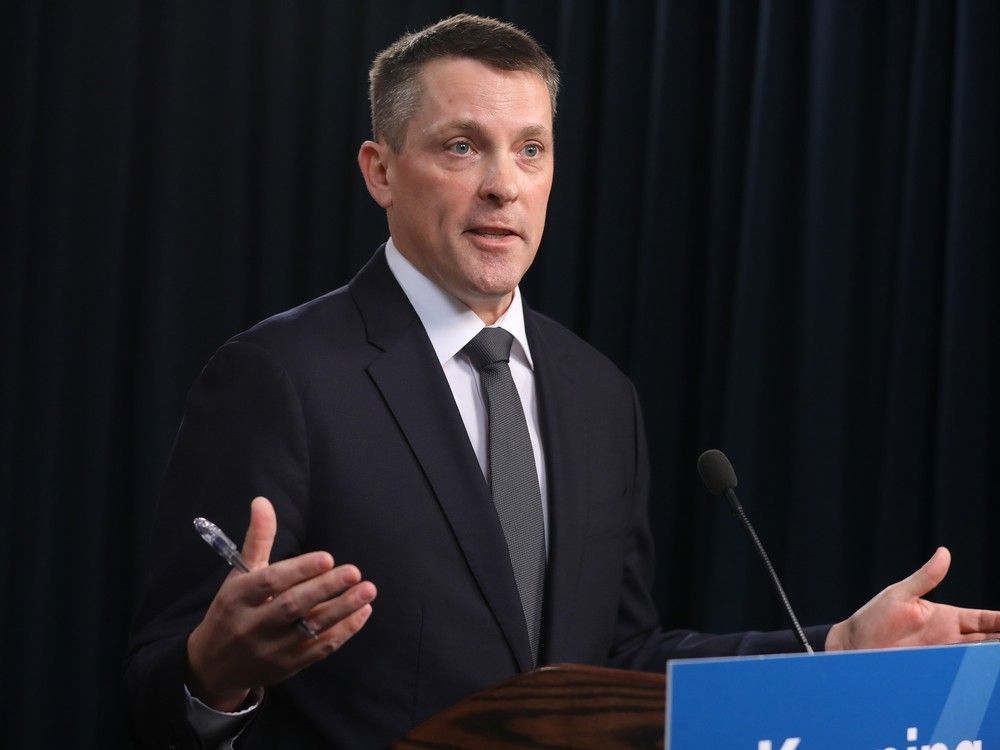
Finance Minister Nate Horner. Photo by David Bloom /Postmedia, file Article content
Oil prices are down, expenses are up, population’s still growing ahead of national rates — these are the downward pressures keeping the Alberta economy in check and the deficit up.
THIS CONTENT IS RESERVED FOR SUBSCRIBERS ONLY
Subscribe now to read the latest news in your city and across Canada.
Exclusive articles by David Staples, Keith Gerein and others, Oilers news from Cult of Hockey, Ask EJ Anything features, the Noon News Roundup and Under the Dome newsletters. Unlimited online access to Edmonton Journal and 15 news sites with one account. Edmonton Journal ePaper, an electronic replica of the print edition to view on any device, share and comment on. Daily puzzles, including the New York Times Crossword. Support local journalism. SUBSCRIBE TO UNLOCK MORE ARTICLES
Subscribe now to read the latest news in your city and across Canada.
Exclusive articles by David Staples, Keith Gerein and others, Oilers news from Cult of Hockey, Ask EJ Anything features, the Noon News Roundup and Under the Dome newsletters. Unlimited online access to Edmonton Journal and 15 news sites with one account. Edmonton Journal ePaper, an electronic replica of the print edition to view on any device, share and comment on. Daily puzzles, including the New York Times Crossword. Support local journalism. REGISTER / SIGN IN TO UNLOCK MORE ARTICLES
Create an account or sign in to continue with your reading experience.
Access articles from across Canada with one account. Share your thoughts and join the conversation in the comments. Enjoy additional articles per month. Get email updates from your favourite authors. THIS ARTICLE IS FREE TO READ REGISTER TO UNLOCK.
Create an account or sign in to continue with your reading experience.
Access articles from across Canada with one account Share your thoughts and join the conversation in the comments Enjoy additional articles per month Get email updates from your favourite authors Sign In or Create an Account or
Article content
Finance Minister Nate Horner released prognostications for the second-quarter with a fiscal update Thursday, portraying a softening economy and laying it at the feet of tariffs imposed by U.S. President Donald Trump.
Article content
Article content
Article content
“It should come as no surprise to anyone that we are facing serious financial challenges this year. Last year, we had a surplus in cash available to allocate to the Heritage Savings Trust Fund to help grow it for future generations. However, with U.S. tariffs, we knew this year would be very different,” Horner said.
Article content
By signing up you consent to receive the above newsletter from Postmedia Network Inc.
Article content
The new energy agreement hammered out just in time between the province and Prime Minister Mark Carney is expected to be a hero in future budgets, increasing investment certainty, attracting opportunity and strengthening the Canadian economy.
Article content
“It will mean a lot for the future this province,” Horner said. “It won’t help us this year or help us next year, a lot is going to depend on when there’s actually shovels in the ground. The great thing that we’ve seen from the Trans Mountain expansion is the narrowing of the differential, which has largely offset a lot of this drop in the price of West Texas Intermediate,” Horner said.
Article content
Article content
“And that’s no part due to the pickup of Asian markets, seeking out heavy oil, so it will mean a lot for us down the road,” he said.
Article content
Article content
Horner cited global trade tensions, lower oil prices, and ongoing economic uncertainty as weighing on the province’s finances in a “challenging financial year.” He promised the government would be taking a close look at spending on existing government programs.
Article content
“I think we’re definitely going to look at them. You know, that’s been my commitment, that we’ll turn over every rock. We need to make sure that it continues to be a priority of the province. You know, there’s no way that I can have the capacity to balance this budget through cuts. I don’t think that’s what Alberta needs right now, but we need to ensure that we’re not outliers compared to the other provinces. And we need to ensure that the things we’re spending on are still the top priorities of today, and that will all manifest itself through some tough conversations, no doubt,” he said.
Article content
With more jobs in the service, health care and education sectors in the second quarter, Alberta’s real GDP growth is expected to lead the country at 2.1 per cent and improve, but remain down significantly from last year’s three per cent, Horner said.
Article content
Real manufacturing is expected to decline by three per cent in the coming year, he said.
Article content
The projected second-quarter $6.4-billion deficit will be $1.2 billion more than estimated in Budget 2025. It is down $40 million from the first quarter, though.
Article content
Alberta’s total revenue for 2025-26 is expected to come in at $73 billion, down $1.2 billion from Budget 2025.
Article content
Personal income tax revenue is down $457 million from budget, thanks to lower-than-expected 2024 tax assessments.
Article content
Corporate income tax revenue was the main revenue category champion — holding steady (up $236 million from budget) and forecast to soldier on at $7 billion in 2025-26, reflecting “the economic resilience in Alberta’s economy so far this year amid trade uncertainties,” the report said.
Article content
Article content
Other tax revenue is up $23 million from budget, helped by gains in fuel tax from increased gas sales and offset by a decline in tobacco tax revenue.
Article content
Federal transfers are up $222 million from budget, thanks to $73 million for the Canada health transfer and $23 million for the Canada social transfer.
Article content
The province’s total expenses are forecast at $79.4 billion, up $52 million from budget, in every operating category across the board.
Article content
Oil revenue flat
Article content
The big dip is a 30 per cent decline in natural resource revenue from 2024-25. This puts estimated non-renewable resource revenue at $15.4 billion in 2025-26, down from a peak of $25.2 billion in 2022-23.
Article content
The $1.7 billion drop in non-renewable resource revenue from the budget is attributed to lower bitumen royalties and broad-based reductions in conventional oil, natural gas and byproducts royalties.
Article content
Article content
The West Texas Intermediate benchmark is down US$6.50 from the Alberta budget estimate of US$68 per barrel.
Article content
The price of oil has decreased about US$28 per barrel since 2022-23, when the price of oil averaged more than US$89 per barrel.
Article content
If oil prices rise to the projected US$61.50 per barrel West Texas Intermediate price and stay low throughout the fiscal year because of ongoing weakness in global markets, the government projects the widening deficit should also stay steady with first quarter numbers at around $6.4 billion, up from Budget 2025’s estimate of $5.2-billion deficit for 2025-26.
Article content
The province is tracking shifts in sentiment towards the oil industry, and concerns for a supply glut in 2026.
Article content
The geopolitical premium has been reduced in recent months with activity in the Middle East. OPEC has backpedaled plans to increase production in the first quarter of 2026.
Article content
On the upside, Alberta oil production is going at a record clip, refinery margins have been “very strong,” and exports are performing better than expected, particularly with the Far East.
Article content
Money for private health care
Article content
Continued emphasis on the provincial government’s two-tier public/private system includes contingency funds of $81 million for partnerships between government and chartered surgical facilities, and the development of an “in-province surgical voucher” program.
Article content
Some $40 million will fund new temporary beds and non-bed spaces for continuing care.
Article content
A $43 million increase will fund new psychiatric beds, and an early implementation of “compassionate intervention.”
Article content
Bright spots
Article content
The 2025-26 Capital Plan is forecast at $8.8 billion, up $154 million from Budget 2025. This increase includes $106 million in capital investment and $48 million in capital grants.
Article content
Article content
The number of building permits are up significantly in the institutional and government category, up more than 140 per cent year to date.
Article content
Institutional government building is a strong sector, with hospital, supportive housing, and school construction up 74 per cent year-to-date.
Article content
The province quietly passed the five million population mark, and is still growing at the fastest rate among provinces with 2.5 per cent population growth expected this year, expected to slow to lass than two per cent in 2026. The downside for those numbers is higher unemployment among young Albertans.
Article content
In the trade column, manufacturing, particularly food, chemicals, wood products and agriculture, are grappling with roller-coaster tariffs and trade uncertainty, prompting businesses to put off hiring until a more stable economic moment.
Article content
Although the private sector is expected to soften for the next few years, tariffs haven’t impacted Alberta as hard as some other provinces (presumably with differences in their manufacturing and export sectors), the report found.
Article content
Article content
Expected second-quarter outcomes include “solid job growth” (and the provincial unemployment rate to recover down half a per cent from its current expected 7.4 per cent jobless rate) and inflation remaining “under control.”
Article content
Contingency
Article content
The government increased the contingency margin to $4 billion in budget 2025 in part to cover spending increases as collective bargaining agreements are settled as of the second quarter, Horner said.
Article content
“We’ve allocated roughly $1.7 billion of the contingency,” he said.
Article content
As of Q2, the government is allocating $711 million for emergency and disaster assistance, including wildfire response, emergency evacuation payments and tree replanting
Article content
The adjusted operating budget includes $881 million from contingency for a bevy of new labour agreements reached in the first and second quarters with several large public sector unions, including those representing Alberta’s registered nurses and civil servants. Set aside is $240 million for ATA collective bargaining agreement, $470 million for various health unions, and $234 million across departments for the recent AUPE settlement.
Article content
Those contingencies were offset in part by some savings, including a $78 million decrease in AIMCo investment management services, a $36 million decrease in technology innovation and emissions reduction due to updated modelling and economic data, and a $9 million reduction in the first quarter resulting from freezing the TIER Fund price at $95 per tonne of emissions.
Article content
There was also a $19 million decrease due to lower costs for selling oil, driven by a decrease in purchase volumes and the price of West Texas Intermediate, in addition to a $64 million reduction in the first quarter forecast.
Article content
The 2025-26 Heritage Savings Trust Fund second-quarter report notes that its value is forecast at $31.5 billion as of Sept. 30. The fund earned $770 million in net investment income over the second quarter, according to the report.
Article content
Article content
Article content
Article content
Article content
Article content
Article content
You can also support our journalism by becoming a digital subscriber. Subscribers gain unlimited access to The Edmonton Journal, Edmonton Sun, National Post and 13 other Canadian news sites. The Edmonton Journal | The Edmonton Sun
Article content
https://edmontonjournal.com/news/local-news/low-oil-prices-and-tariffs-result-in-6-4-billion-projected-second-quarter-alberta-deficit